text © Don Davis
The first V-2 and the dawn of the Space Age
The developments leading to rockets capable of lifting spacecraft have their origins in weapons development. Technology is available, as is much of everything, to destroy or to build. The use of rockets to explore space later became the means of understanding many things formally unknown to us, giving us the insight to ask more questions of the Universe. A historic benchmark on our path to this knowledge was the first successful flight of the 'V-2' rocket on October 3, 1942, the day the rocket graduated from a firework to a vehicle.
Because of a vivid recollection
which Krafft Eriche personally shared with me of that first successful
V-2 launch, while we attended the Apollo 17 launch cruise, I felt
inspired to learn what I could of that great moment. Such an event
is a tangible expression of many underlying causes and trends,
and a brief sketch of some of these is given as the background
to this technological milestone, which approached the atomic bomb
itself as the most significant invention of the Second World War.
In this presentation of the first successful
flight of the V-2 and its historic background, the written accounts
of the participants were used whenever possible, particularly
the detailed recollections of Dornberger and Von Braun which appeared
in 'The Coming Of The Space Age' edited by Arthur C. Clarke. Where
Dornberger and Von Braun's accounts differ I defer to Von Braun.
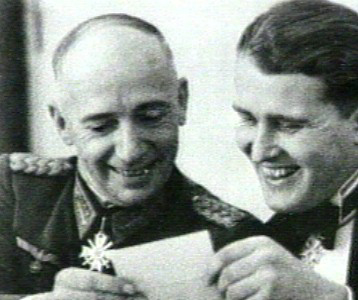
Dornberger
& Von Braun
The romance of big rockets excited
the imaginations of several important Germans who realized what
could be done with enough resources. In a society rebounding from
losing the 'War To End All Wars', rockets were adopted as a cause
by many young enthusiasts in the wake of circulation of ideas
of space travel in literature. The publication of Hermann Oberth's
1923 book 'The Rocket In Interplanetary Space' marks an early
Post Tsilkovsky conceptual elaboration of the potential of Rocketry.
Fritz Lang's 1928 Frau Im Mond ('Girl
on the Moon') had appeared in theaters as among the last of the
silent movies. This influential film introduced to the screen
many of the elements familiar to space enthusiasts such as the
stage rocket, and the effects of acceleration and weightlessness.
The most enduring legacy of this film was the dramatic device
of the countdown of the last seconds before the ignition of the
rocket. This was later adopted as practice for actual launches
as well as for nuclear bomb tests! Oberth was sought out as technical
advisor on the film, and he tried unsuccessfully to build a liquid
fuel rocket for the premier of the movie.
German Rocket enthusiasts, with networking between
them facilitated by Willy Ley, actually built small but functioning
liquid fuel rockets which relied on combining fuel elements through
complex plumbing to create a controlled combustion. This is fundamentally
different from the ancient powder filled tubes invented by the
Chinese in the early 1200's. One of these new rockets climbed
over 1000 feet in October 1931. The next year the German
Army showed interest in their work with Captain Walter Dornberger,
head of powder rocket development, visiting their facilities.
In 1929 Dornberger had been assigned the task, by Army Ordinance
development, of developing a rocket capable of greater range than
Germany's legendary 'Paris Gun' which lobbed shells 65 miles during
the World War. What Dornberger saw led to his offer to key personnel
to work for him in an Army development program. Among these young
tinkerers was Wernher Von Braun, most gifted of that generation
of German rocketeers.
After spirited debate some of them took the
offer, seen as an opportunity to perform the kind of Research
and Development they had only dreamed of with the pocket money
previously available. After years of doing work in garages it
must have seemed miraculous to see buildings, test stands, and
manufacturing plants spring up to support their needs. They
were defining the essentials of a new technology, as other individuals
in other countries were doing, except that one country's government
generously funded the crucial research and development and the
others didn't. Although obviously a tool for war at its inception,
the potential for other uses later on must have been a factor
in the motivations in at least some of these people. Rockets
were not specified as forbidden by the treaty Germany was bound
by following it's defeat in the first World War, so pouring money
into developing such vehicles could proceed without raising international
alarm. Within a few years working liquid fuel rockets were
being fired from test stands. The many failures were dealt with
and the art of rocketry began to mature. The versatility and inventiveness
of the rocket team was shown in January 1935 when Major Von Richthofen,
a cousin of the famous ace, paid the facilities a visit to express
curiosity about using rockets to propel aircraft. Within 6 months
a Heinkel fighter plane was modified to carry a rocket engine
which was operated by the pilot. This was test fired on a stand
for Von Richthofen, who was greatly impressed with the speed with
which the work had been carried out as much as it's success. Thereafter
money poured into the place, the larger scale of the operation
causing the facility to be moved to Peenemunde, an isolated peninsula
of land from which significant work could be done without attracting
undue attention.
By mid 1937 most of the old rocket crowd had
been gathered into Dornberger's group, of which Von Braun was
the most important in the overseeing of the work. Von Braun and
the other technicians had to join the National Socialist party
in order to continue their work, although ironically the Nazi
party was largely hostile to intellectual and academic interests. Among
the prominent people the gifted engineer Arthur Rudolph was rare
in apparently being an enthusiastic Nazi, joining the party early
in its ascendancy. Dornberger used his diplomatic and political
abilities to protect Von Braun and the others from the predatory
bureaucrats lurking in the Nazi government. A few other influential
visionaries saw to it the program was nursed through periods of
wavering support. Many military development projects were
under way in Germany at the time, often redundant but a few truly
important. A few of these, such as the deployment of Jet fighters,
were subject to irrational delays often initiated by Hitler himself.
Adolf Hitler tended to mistrust new technologies evolving since
his World War I career, and was slow to grasp their advantages.
At times he even seemed to let omens he saw in dreams affect his
priorities. By the late 30s the process of rocket development
had attracted some influential fans, including Army Supreme Commander
Field Marshall Von Brauchitsch, and most importantly the powerful
Minister of Armaments Albert Speer. In 1939 Hitler cut off funding
for big rockets, however Speer and Von Brauchitsch arranged for
hefty production contracts for Peenemunde to keep the facility
busy. Speer continued to arrange covert funding for large rockets
in what became a 'pet project' for him during the early crucial
years of development.
In a sheltered supportive environment the Peenemunde Group labored to quickly develop a large military rocket. Besides having a range considerably greater than that of the shells from the Paris Gun, a design constraint was that the missile had to be able to fit through existing railway tunnels. The final design for their big rocket, initially called the A-4, was a 46 foot long behemoth which could hurl a one ton warhead up to 200 miles. It's smooth aerodynamic shape and streamlined fins had the exotic look of a visitor from the future. Engineers and various ranks of workers of very different status, such as university professors, specialist prisoners of war, and soldiers worked on the project. In those days people had jobs as 'computers', almost all women. These rows of slide-rule wielding ladies at their desks in one building were called the 'measurement girls'. One group of these 'computers' used so much paper to display trajectory data they were nicknamed the 'wallpaper girls'. Recruitments of competent people was done through universities and through a unique device of creating a specialized 'battalion' of personnel with scientific and technical skills drawn from the general military population. Among the people suddenly finding themselves ordered to Peenemunde was a tank platoon leader who had fought from Dunkirk to the suburbs of Moscow, Krafft Ehriche. In the spring of 1940 Wernher Von Braun was approached by an aid of Reichsfueher SS Heinrich Himmler who urged that he join the SS. After getting Dornbergers advice, Von Braun finally wrote his consent and was promptly appointed a Lieutenant, with yearly promotions.
The year 1942 was an especially
crucial year of World War II. Hitler's conquests had made him
the ephemeral master of Europe. Germany's penetration of Russia
was reaching it's peak, with Stalingrad becoming the focus of
vast resources for devastating attacks by the Germans and unrelenting
defense by the Soviets. The two armored Colossi of Western and
Eastern Europe were locked in a death struggle, as vast as the
rest of the Second World War put together. Some German technical
advancements which could have changed history for the worse if
fully exploited fell victim to fundamental weaknesses in the mentality
of the Nazi ruling elite and the wartime disruption of industrial
production. Jet and rocket propulsion were being tried in fighter
aircraft, but the jets underwent years of delay to satisfy Hitler's
irrational whims. The tiny Komet rocket fighters, admittedly fast
and deadly, were woefully brief in their powered flight after
which they helplessly glided to a touchdown on a ski like skid.
A few of the Komets would blow up suddenly in flight for no apparent
reason.
On June 13, 1942 the first full scale test flight of an A-4 was
attempted. After rising for one second the thrust stopped, causing
the giant projectile to settle back to Earth, the fins crumpling
as it tumbled on it's side. Smacking into the concrete, the fuel
filled body burst like a great water balloon then flashed violently
into a billowing inferno. Number 2 was launched August 16,
and rose majestically until it spun out of control and exploded
about 45 seconds into the flight, about 8 miles high. Unfortunately
a lot of VIPs were witnesses to that failure. The pressure was
on. The midsection of the missile was strengthened, and ongoing
design improvements were incorporated into the next flight vehicle. By
this time a 'do-or-die' sentiment made everyone especially careful,
knowing the hazards of being an expensive exotic government program
unable to produce results in wartime.
The turning point came on the third try.
The morning of October 3,
1942 was clear and beautiful at the Peenemunde complex. Atop
one of the camouflage draped buildings Captain Walter Dornberger
stood with a microphone in one hand, his powerful binoculars in
the other. Near him a small television apparatus provided a tiny
pale picture of the A-4, which was hidden from direct view by
a tree covered low hill. The benevolence written into his features
was starkly highlighted in the bright sun with lines of worry.
This was probably going to be the critical demonstration of the
worthiness of the idea he and his gathered talent had long slaved
for. Next to Dornberger stood his lifelong friend, Colonel Leo
Zanssen. Both men had no love for the Nazis and as a military
commander of Peenemunde Zanssen had assisted Dornberger in keeping
the Party types at arm's length.
The paved facilities around them gave away in
the distance to green marshlands and coastal forests. A red brick
cathedral stood above the green hills, clear in the sunlight.
Nearby other observers were taking their places. On the isolated
launch pad stood the results of everyone's best work, eagerly
watched through periscopes by engineers in their nearby concrete
buildings, others watching through closed circuit television.
Further away, among and atop the buildings, every vantage point
was swarming with spectators, There were many people 'in the know'
but not really supposed to be there. Tinny voices on loudspeakers
barked out the status of the various systems, and engineers were
queried on how their part of the process was going. A voice over
the loudspeaker called out "X minus three, Counting off".
Swinging his binoculars sideways, Dornberger
spied Wernher Von Braun among a small group atop a nearby building.
Apart from them sat a pair of professional observers, both peering
through special binocular periscopes and giving their own accounts
of what they were witnessing, each with a secretary taking down
what they independently said. White vapor poured from the Oxygen
tank valve near the base of the rocket, with a band of frost encircling
the location of the oxygen tank itself well above the middle of
the vehicle. The access platforms were moved away, leaving the
massive projectile standing alone as Man's newest challenge to
the sky. The tall rocket displayed the graceful tapering contours
dictated by the extremes of physical forces it would experience,
a vision of the future.
"X minus one" barked the announcer. The
Pennemunde Minute, legendary for it's subjectively great length,
had begun. The preparations were over, and the situation was in
the hands of the kind of fate people have long prayed to in hopes
of influencing it as they stand helplessly by. Dornberger forced
himself to stare at the television image of the rocket and not
at his watch. A green smoke trail appeared as a flare signaling
10 seconds left was fired. The wind changed it's shape only slightly.
"Ignition" was loudly announced as sparks sprayed from
the engine nozzle and quickly turned into a violent column of
flame roaring against the concrete. Cables fell away from the
rocket, smoke billowed around it and the missile was then operating
under it's own battery power. The announcement "Cleared"
was made as the final buildup of thrust carried it's force past
that needed to lift the 13.5 ton vehicle. Slowly, magnificently,
the pointed tip of the A-4 rose above the smoke and into the view
of everyone.
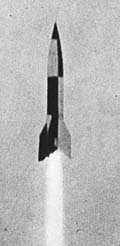
Dornberger saw it seemingly emerge from the
treetops through his binoculars, gleaming in the Sun against first
the distant green scenery then the blue sky, unleashing a column
of bright flame as long as the rocket itself. It rose steadily
along it's intended path, straight and true with no spinning.
Five seconds after ignition, the thunder of the launch reached
the buildings, the waves felt as well as heard while rippling
through everything. The roar filled the skies and rolled over
the forest and across the oceans beyond. Higher and faster the
rocket climbed, becoming lighter as fuel was spent, the continuous
engine thrust acting against less weight every moment. Slowly
the missile began it's programmed tilt in it's path to achieve
the desired 45 degree angle for maximum range. The rocket's roar
began to change into a sputtering of slowly lowering tone, with
other local noises gradually emerging from the din.
 The
seconds elapsed since the flight began were counted out continuously
on the loudspeaker, but other speakers gave information, such
as a 'measuring tone' of a slowly changing pitch broadcast from
the rocket which gave an audible indication of the speed the vehicle
was traveling due to the sensitivity of the receiver to the 'Doppler'
shift of the rocket's transmitter. The tone was changing from
a low humming to a piercing trill as the speed built up. During
the otherwise monotonous counting, occasional flight milestones
were announced, such as "Sonic velocity". Now supersonic
speed had been reached! Through the binoculars the rocket, shortened
by perspective, spouted it's orange flame brightly against the
dark blue heavens. A half minute had passed, and double the speed
of sound was reached. The rocket now flew higher than any mountain
on Earth. Just after 40 seconds into the flight a vapor trail
appeared, with alarmed murmurs from the crowd expressing fears
that the rocket had exploded. An announcer reassured everyone
what they saw was simply the oxygen vent opening.
The
seconds elapsed since the flight began were counted out continuously
on the loudspeaker, but other speakers gave information, such
as a 'measuring tone' of a slowly changing pitch broadcast from
the rocket which gave an audible indication of the speed the vehicle
was traveling due to the sensitivity of the receiver to the 'Doppler'
shift of the rocket's transmitter. The tone was changing from
a low humming to a piercing trill as the speed built up. During
the otherwise monotonous counting, occasional flight milestones
were announced, such as "Sonic velocity". Now supersonic
speed had been reached! Through the binoculars the rocket, shortened
by perspective, spouted it's orange flame brightly against the
dark blue heavens. A half minute had passed, and double the speed
of sound was reached. The rocket now flew higher than any mountain
on Earth. Just after 40 seconds into the flight a vapor trail
appeared, with alarmed murmurs from the crowd expressing fears
that the rocket had exploded. An announcer reassured everyone
what they saw was simply the oxygen vent opening.
Now that this rocket had lasted longer than
it's predecessor, each moment was spent in new territory. Other
voices expressed fears the rocket was flying erratically when
what they observed was actually the initially straight vapor trail
being stretched about by swift high altitude winds. Until that
moment only meteors had left trails at such altitudes. At the
54 second mark the engine cut off was announced, and through binoculars
only the glowing vanes along the inner edges of the rear fins
were seen as a tiny white speck at the base of still climbing
rocket.
The A-4 was sailing higher than any human being
would go for another 18 years. If one could accompany the missile
the sky above would be jet black, with brighter stars and a diagonal
line of planets visible in the same sky as the brilliant morning
Sun. The distance to the horizon would be a thousand miles and
growing, with the curvature of the Earth obvious. A fuzzy envelope
of luminous air would separate the dark blue seas and lushly forested
coastlines below from the eternal empty vastness above. With practically
all the air left behind, the rocket arced in a graceful mathematical
path unhindered by wind resistance in a sterile vacuum environment.
Unfiltered sunlight harshly illuminated one side of the projectile,
outlining in crisp shadows every dent and rivet along its length.
A painting of a woman sitting on a V-2 looked out from between
the fins of the missile towards the actual crescent Moon high
in the southwestern sky. As the A-4 reached the peak of its arc
it skimmed the realm of the rest of the universe.
Dornberger at last put down his binoculars,
drawing his breath slowly. It had worked! A decade of work had
made a huge mark on History! Turning to Zanssen, who was tearfully
laughing, they shook hands, yelled, and gleefully embraced like
victorious schoolboys at the end of an important ball game. Atop
and between buildings people were shaking hands, clapping, and
even dancing. Dornberger descended from his vantage point and
grabbed a vehicle, weaving his way through the jubilant confusion.
Spying Von Braun, he pulled him into the car and careened to the
launch site to join the people gathering there. The scene at the
smoldering pad was chaos as everyone babbled their impressions
to the senior staff present. The flame's effects on the firing
area was worse than expected but would be planned around the next
time. By now the rocket was in it's fourth minute of flight, falling
with great speed.
Dornberger hushed everyone up to hear the end
of the flight take place. The tone broadcast from the rocket still
sounded, but the 3000 mile per hour speed of the missile was about
to be quickly slowed by one third as it re-entered the dense atmosphere,
and the danger of overheating and breakup haunted him as a moment
of truth no less than the actual launch. Then, a few seconds short
of 5 minutes of flight, the measuring tone abruptly began lowering
as the speed dropped during the atmospheric descent, with the
word "Impact" cutting off the tone. Now it was an unqualified
success! A dye capsule in the rocket would reveal it's location
to a search plane. The impact point was some 124 miles distant,
with an altitude of nearly half that having been reached.
Professor Hermann Oberth ran out of a building and
clasped hands with Dornberger with congratulations while exclaiming
"This is something only the Germans could achieve!"
The crescent Moon with a lady sitting on it painted on the
fin was in honor of the film 'Frau im Mond', for which Oberth
was technical advisor. Dornberger replied to Oberth "The
day on which we had been privileged to take the first step into
space must also be a day of success and rejoicing for you, and
that the congratulations must go to you for showing us the way".
At the foot of the building Dornberger had witnessed the launch
from an engineer had just placed a large boulder with the words
"A great weight has fallen from my shoulders" painted
on it. That evening a small celebration was held in the officer's
club with many key workers on the project addressed by Dornberger,
who clearly saw past the immediate use this invention would be
put as he said:
"The history of technology will record that for the first time a machine of human construction, a 5.5 ton missile, covered a distance of 120 miles with a deflection of only two and a half miles from the target. Your names, my friends and colleagues, are associated with this achievement"..."Our self steering rocket has reached heights never touched by any man-made machine. Since the tilt was not carried to completion our rocket today reached a height of nearly 60 miles. We have thus broken the world height record of 25 miles previously held by the shell fired from the now almost legendary Paris Gun. The following points may be deemed of decisive significance in the history of technology: We have invaded space with our rocket and for the first time-mark this well-have used space as a bridge between two points on the Earth: We have proved rocket propulsion practicable for space travel. To land, sea, and air may now be added infinite space as a medium of future intercontinental traffic. This third day of October, 1942, is the first of a new era in transportation, that of space travel..." The lecture then turned to the need to develop and deploy the new weapon as soon as possible.
In some ways that day became the peak experience of the Rocket Team's German days. Never again would the accomplishments of Peenemunde seem to offer so much potential, nor would the wartime environment again be so friendly towards realizing their dreams. But the power of that day's triumph radiated forth like the sound of a shot in the night.When Speer mentioned the success of the test to Adolf Hitler, the Fuehrer at last took an interest in the project. A meeting between Hitler, Dornberger, and Von Braun took place on July 17, 1943.
In the three quarters of a year since
that first successful A-4 flight the War had taken disastrous
turns for Germany. Early in 1943, after running the gauntlet of
the fortunes of war, dwindling supplies and the freezing weather,
the remnants of the army trying to take Stalingrad hobbled through
the snow in long tattered lined into surrender. This event, perhaps
the most intensely concentrated battle in history, marked the
pivotal turnaround in the war with Russia. The recent surrender
of the famed Afrika Corps during the loss of North Africa was
another alarming loss of territory under German control. The Battle
of Kursk, both the largest tank and air battles in history, was
about to grind away the last hopes by Germany to regain the initiative
in the East. The walls were slowly closing in on the Reich, and
drastic new weapons seemed more inviting.
As Von Braun and Dornberger waited for their
audience, they kept reviewing what would be said. Finally they
were admitted to Hitler's presence with pomp and ceremonial announcements.
The Fuehrer stepped forwards, from the first moment appearing
not quite so 'bigger than life' as he once was. To Dornberger
the strain of the recent years on Hitler's appearance showed alarmingly,
with an appearance of weariness and a stooped posture the main
differences noted from his 1939 meeting. The man who had been
able to project a Messiah like persona before millions was turning
into the reclusive over medicated tyrant of his last days. Accompanying
the harried dictator were Speer and other top officials with their
aides.
Von Braun knew his presentation well, leaping
into an enthusiastic description of the workings of the rocket
and it's effects upon impact. At this point Hitler interrupted,
and cautioned that a very sensitive fuse would be needed to assure
the warhead didn't bury itself to excessive depth before exploding,
thus limiting it's effect. Hitler was never shy on offering his
opinion on anything. The rest of the lecture went well, and at
the proper moment the lights were dimmed and a color film of the
October 3 test was shown. The vision of this streamlined leviathan
hurling itself skyward upon a pillar of fire transfixed Adolf
Hitler. As the rocket roared to life on the screen the fires of
the previous decades reawakened in his piercing blue eyes. It
was as if the deliverance he yearned for was being revealed to
him, and sudden hope animated his further intrigued inquiries.
His desperate imagination brought significance beyond rationality
to what this weapon could mean to the war. Amid an obsessive tirade
on the need to build more destructive weapons of this type, he
paused for a moment and reflected "Europe and the World will
be too small from now on to contain a war. With such weapons humanity
will be unable to endure it."
Hitler than gave the A-4 weapon the highest
priority, at least in his mood of the moment. When Von Braun returned
to Peenemunde, a check on Hitler's concerns of delayed detonation
upon impact proved them to be valid! Hitler had a knack for inspired
intuition but often trusted it in inappropriate domains. A funding
crisis in the program was initiated by a dream Hitler supposedly
had suggesting the V-2 would be a failure. Similarly reasoned
decisions fatally delayed the appearance of German jet fighters
and imprudently cut back on arms production while operating under
optimistic war scenarios. In the mean time Germany began fighting
a grim 'delaying action' war, especially against the Russians.
Although the Germans would inflict lopsided casualties on the
Russians, desperation increased as the territory under German
control steadily dwindled. In the meantime Allied bombing increasingly
disrupted the industries needed to quickly bring about the dreams
of the engineers. Only a few projects went anywhere, such as a
primitive cruise missile called Vengeance Weapon 1 or 'V-1' by
the Propaganda Ministry and of course the forerunner of the ballistic
missile the A-4 renamed by Goebbels the 'V-2'.
The Olympian days of German rocket development were
over. It was time to turn the missile into a weapon. Long gone
were the days of public exposure to ideas of space travel in Germany.
In the meantime German news media had been forbidden to use the
word 'rocket' at all, and every copy of Lang's film Frau im
Mond within German reach was quietly confiscated and destroyed.
With success at Peenemunde came interest from the dreaded Heinrich
Himmler, with his overtures followed by heavy-handed measures
to move the SS into the rocket game. In a meeting called by Himmler
in February 1944 at his East Prussian headquarters, Von Braun
found himself being invited to join the inner staff of the man
he described as being "as mild mannered a villain as ever
cut a throat". In his polite delivery Himmler assured him
of greater access to the Fuehrer and the end of delays caused
by Army red tape. Von Braun quickly reiterated his loyalty and
admiration for Dornberger, emphasizing the delays were primarily
due to technical and not organizational causes. Von Braun then
faced down Himmler, telling him that the V-2 was like a fragile
growing flower which needs sunshine, a gentle gardener, and a
measured amount of manure. What Himmler was proposing, he then
said, was like a jet of liquefied manure which could kill the
little flower! .
Two weeks later Von Braun and others were arrested
by the Gestapo, facing a treason charge which in wartime Germany
was courting a death sentence. Although they were evidently spared
the brutality most others similarly charged went through in the
hands of the SS, they were indeed being taught a lesson! After
two weeks they were rescued by Dornberger successfully appealing
to Speer and even Hitler for his rescue, on the grounds that without
Von Braun there would be no V-2. By this time, however, the
introduction of such a weapon was of declining importance to the
outcome of the war.
Continuous high priority status
may have led to the missile being available close to a year earlier.
Allied bombing and shrinking frontiers steadily pinched off necessary
supplies for this and other new weapons. In a way the very pursuit
of the V-2 project sapped the efforts of rocket specialists who
might have developed better air defense methods which, along with
the jet fighters properly deployed, may well have defeated the
allied air offensives. Speer later actually regretted his going
out of his way to push the V-2 rockets, each one of which used
nearly enough resources to build a fighter plane. It was yet another
fatal error in the conduct of the war which saved the world from
a German plunder based slave empire. Within Hitler's shrinking
realm, suffering beyond precedent continued, largely due to the
activities of the dreaded SS carrying out Hitlers dark agenda.
In the wake of a devastating air raid on Peenemunde in August
18-19, 1943, rocket production shifted to the dank realms of the
new massive underground facility near Nordhausen in the Hartz
Mountains. The failed attempt to kill Hitler on July 20, 1944
caused a violent purge of German Army officers including the head
of Army armaments Friedrich Fromm, who had the misfortune of being
the commanding officer of Lt. Col. Klaus Von Stauffenberg, the
man who left the briefcase bomb in the conference room. Himmler
assumed the imprisoned Fromm's duties, and the leadership of the
Rocket program soon passed from the best of Germany's Prussian
military tradition, represented by Dornberger, to it's worst represented
by the man Himmler soon appointed to run the rocket program.
SS Major Hans Kammler was a favorite 'rising star' in the SS and things got really ugly under his influence. Kammler was an icily calculating man whose ambition was matched only by his cruelty. His grim career included the demolition of the ruins left by the bloody suppression of the Warsaw Ghetto uprising, and the overall architectural layout of the Auschwitz death camp including the fabrication of the gas chambers and crematoria. His new project was the 'Mittlework' V-2 factory tunneled within the Mountains. Kammler would gather a work force by the expedient method of mass arrests, boasting openly about the 'protective custody' his workers toiled under. Early in one morning he awakened officers by firing a machine gun, yelling that if he couldn't sleep no one else would! In the deteriorating conditions of the later months of the war he assembled a sizable slave empire, and desperate projects were undertaken with no regard to the human cost. A few of the Peenemunde group who were assigned to work with him were later to regret that association, most notably Arthur Rudolph. This brilliant engineer, after his work on Apollo's leviathan Saturn V rocket a generation later, would be hounded by reports of his working at the 'Mittelwork' plant.
While searching for specialists in various
critical fields among those caught up in the SS roundups, Von
Braun once visited the Buchenwald concentration camp and transferred
prisoners from there to 'Mittlework', which he twice visited to
evaluate their work force. He called for for more French prisoners
to be sent there. This technically made Von Braun guilty of the
war crime of using slave labor. It is also fair to note that Von
Braun is known to have tried to be protective of people working
for him. Thousands nevertheless died at Mittlework under hellish
conditions. Kammler and his underlings worked masses of people
to death in dank noisy tunnels. Shafts being tunneled by prisoners
using hand tools often collapsed, burying in one case hundreds.
Explosions killed more, with subsequent manufacturing improvements
geared towards efficiency rather than safety. Under Kammler's
direction over 1300 rockets would strike England, 518 on London.
In February 28, 1945 Kammler placed a pilot
inside a 'Natter', a small piloted missile. This man, Luftwaffe
Lieutenant Lothar Sieber, became the first person to be launched
vertically in a rocket. The honor was a brief one. After climbing
330 feet, the cockpit bubble tore loose, in some accounts abruptly
decapitating the pilot. At 1600 feet the Natter faltered and dived,
ending this inglorious debut for manned vertical rocket flight.
In the end, Kammler plunged to the depths of depravity, shooting
groups of prisoners himself just for the hell of it. Once over
200 inmates fell victim to one of his blood orgies. Finally he
retreated to his special train, the 'Vengeance Express' and issued
a flurry of orders fewer people each day could hear much less
respond to. Probably realizing his diminishing career potential,
Dornberger heard that Kammler finally ordered an aid to shoot
him before the approaching Russians could capture him. Another
story has him meeting his end in Czechoslovakia in an April gunfight
with partisans. His boss Himmler, after years of a pampered life,
had an especially brutal awakening. Within Himmler's SS empire
Hitler's darkest visions were realized as several groups, especially
the Jews, Russian prisoners of war, and the Gypsies were worked
to death, starved, and murdered by the millions in secluded concentration
camps. The collective list of death and POW camp victims of the
above categories probably approaches 10 million, about 6 million
of that number Jews, which Hitler vowed to exterminate above all
others. Shunned in his pathetic diplomatic overtures to the West,
Himmler, once among the most feared men in Europe, spent his last
days hiding until his capture and suicide.
On April 30, with the walls of his underground bunker shuddering from Russian shells, Hitler shot himself in the temple while biting on a poison vial, his new bride Eva Braun at his side. The blanket wrapped bodies of the newlyweds were carried upstairs and lowered into a shell crater outside the bunker's conical roofed emergency exit. Cans of precious gasoline were poured over them, then ignited with a tossed blazing rag. The battle taking place around the small Viking funeral thundered among the burned out facades of once gleaming edifices, like the rumblings of fierce thunderstorms among jagged peaks. The small gasoline fireball briefly flared, then after initially retreating the small group of officers stepped forward from the shelter entrance to face the pyre and raise their right arms in a final Nazi salute. As the bodies burned before them, the city of Berlin blazed from one end to the other. The sparks rolled skywards in twisting forms as if a malevolent demon was glimpsed in its retreat from its Earthly incarnation.
The bulk of the Peenemunde group migrated amid
the chaos of collapse toward the Americans and away from the Russians.
The story of the archiving of their engineering data and the exodus
Westward, culminating in the surrender to the Americans and their
subsequent adventures essentially continuing their previous work,
has been well described elsewhere. They were fortunately regarded
as valuable by the country the group knew they had the best chance
to continue their work in.
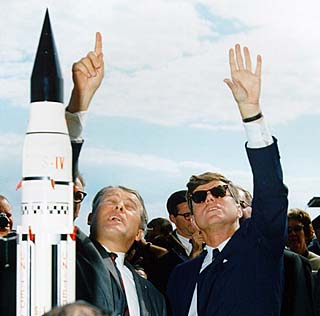
Many of the Peenemunde group ended up crafting
the near mythical behemoths of the Apollo program, the greatest
peacetime project in history. The German rocketeers were able
to finally fulfill their lifelong dreams with the spectacular
Saturn rockets which carried men to the Moon. In two developmental
'windows of opportunity' a generation and an ocean apart, two
very different charismatic leaders important in world history,
Adolf Hitler and John F. Kennedy, sponsored the vital work which
in one case began, and in the other matured, the means to spread
human presence far beyond the reach of those who came before.
In both of these efforts substantially the same
German rocket team worked themselves into the right place and
the right time to assume a pivotal role in fulfilling a grand
vision. The accomplishment of the Moon landings will beam
forth like a lighthouse across the ages as a noble use of a great
nations scientific and technological prowess.
Books referenced for this account:
Clarke: The Coming Of the Space Age. Meredith Press, 1967
Ordway, Sharpe: The Rocket team. Thomas Y.
Crowell, 1979
Speer: Inside the Third Reich. Macmillian Company, 1981
Piszkiewicz: Wernher Von Braun The Man Who Sold The Moon
Yves Bon : Planet Dora