Color
images of many strips of Mars have been obtained by the Mars Odyssey
spacecraft. Overlapping images are captured in numerous wavelengths
including those within the visual range indicated on the spectrum
diagram (left).
Initial releases of the spectacular Mars Odyssey THEMIS images require further work to remove obvious instrumental effects of repetitive nature. The 'framelet' brightness differences seen in varying degrees on many THEMIS images seem likely to benefit from further processing steps. Manually retouching may be the best method of removing obvious light scattering effects seen generally along the edges of many frames. While attempting to manually remove these effects checking between the original and the work in progress is constantly done, with the idea consistently in mind of 'trying to show what the camera system is trying to tell us'. It is better to work on each gray scale color band separately, removing all obvious traces of the 'banding' and partial overexposure. The result of this effort can then be viewed in color, using the 'dodge' or 'burn' tools again on each color channel to carefully fine tune the color balance to match that of the 'better' portions. The image at right shows a screen shot of work in progress on a THEMIS violet channel image, the lower left corner showing the effects of artifact removal. The possibility of leaving many more subtle artifacts in the wake of such work is difficult to eliminate, however I believe the results are an improvement in the resemblance between the images and the subject. Both original and retouched views are provided for comparison. The process of initial artifact removal is aimed toward displaying the original color balance. The further step of trying to approach 'natural color balance' is shown on the next page. The actual RGB colors of Mars are known from recent careful color measurements from Earth based telescopes and the Hubble Space Telescope. the three successful Mars landers to date have provided detailed color information from their locations. Efforts to shift the color to a 'natural' visual impression may well be as much of an art as a science, nevertheless some estimate of how a raw THEMIS color picture should be color balanced is possible with reference to the above resources. In my 'editorially color balanced' adjustments I have been rather conservative in how much I move the colors from the original toward what I think it should look like. I have paid attention to a probable exaggeration of blue colors in the darkest spots of many pictures as discussed below. The least dusty dark rock and dune regions approach being dark neutral gray and can actually be useful as gray references while color balancing in some cases.
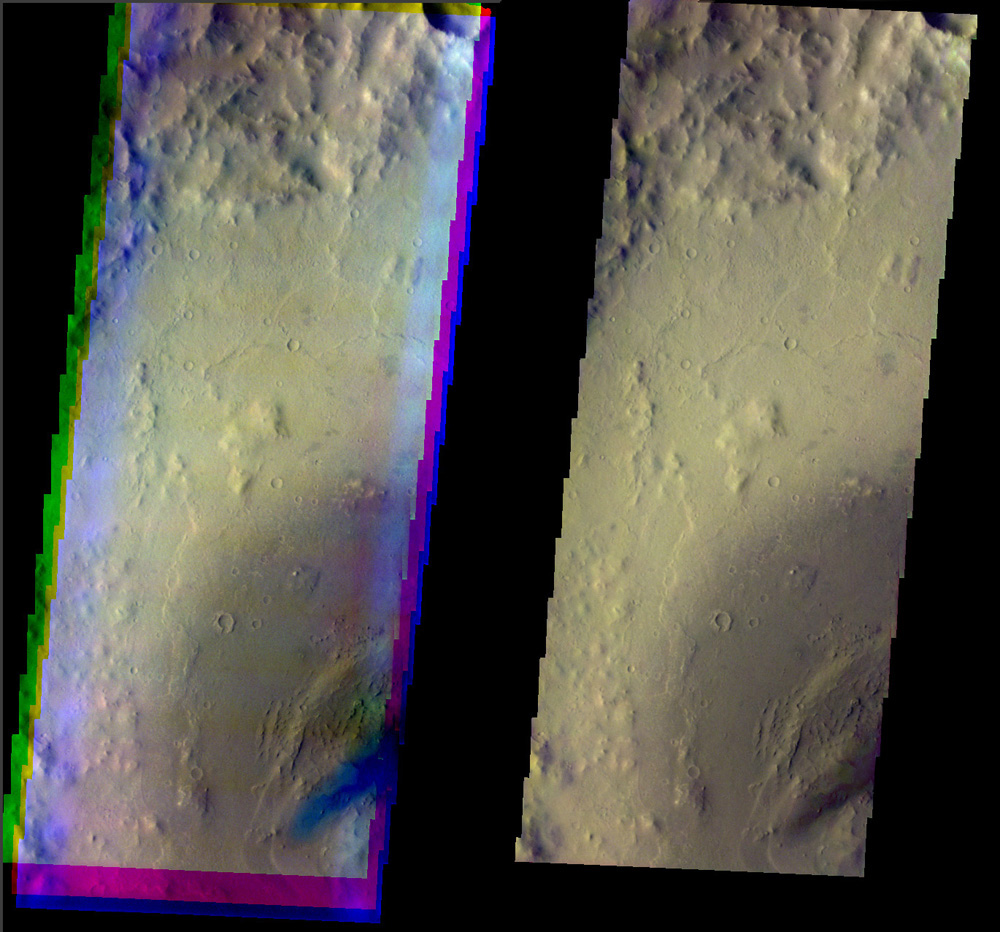
One of my first attempts at 'cleaning up' a THEMIS color image, ( V02401006) presented in its 'raw' form on the left and the results of my effort to remove instrumental artifacts on the right. The general color balance within about the central 70 percent of the raw images was assumed to contain the best color information. The bright artifacts in band 1 generally required the most work, the high fidelity bands 2 and 3 generally being close to flawless.
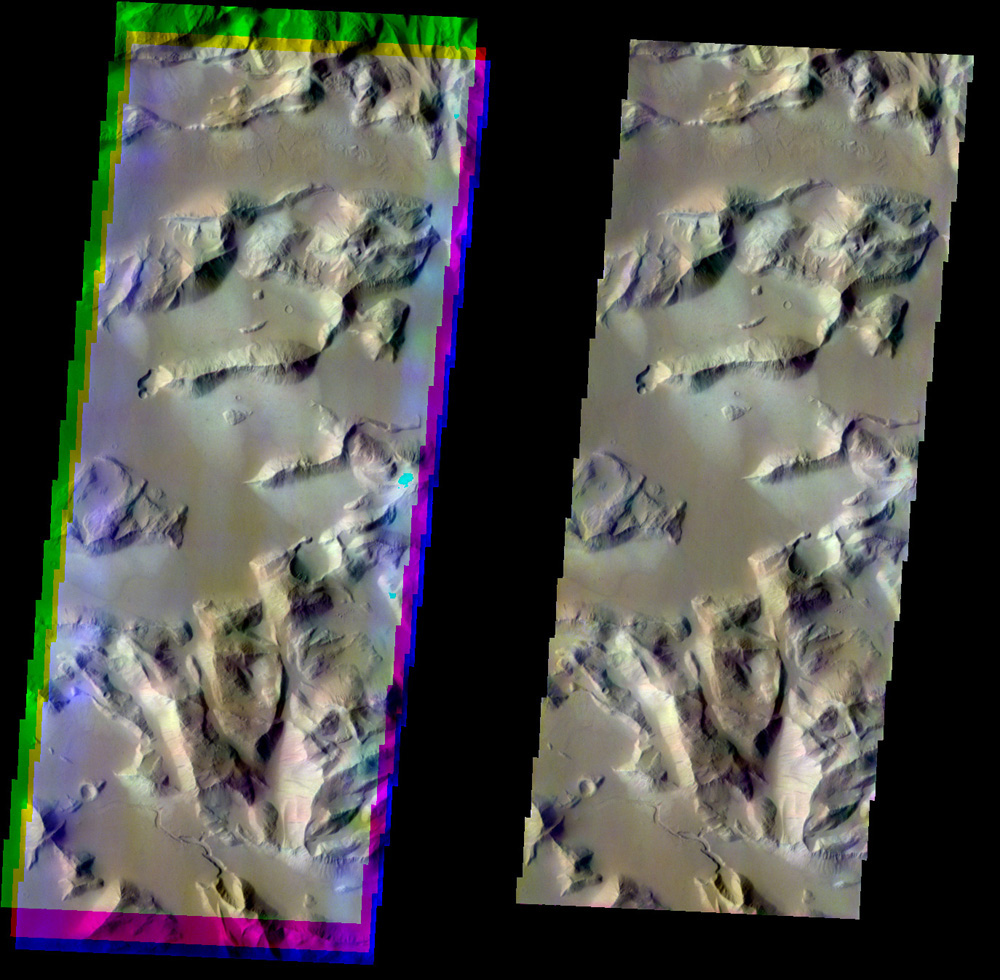
The image (V01797007) below contains a boundary between regions of different albedo. In this case the color is similar in the bright and dark regions. The very darkest streak near the bottom has been recolored assuming the blue channel data was overexposed and that the color is similar to the surroundings. There is still too much blue contributing to a purplish hue in shaded regions. This may be a consequence of using a violet image in place of the blue in the THEMIS color images. (see 'on color and images')