Color in the Solar
System
The planets are individual worlds
which reveal signs of their histories on their surfaces and in
their rocks and ices. Most of the Solar System is fairly narrow
in color range with yellow-brown grays of varying brightness and
saturation predominating. Often I have had occasion to create
images of other worlds, first in paint then digitally. These pages
summarise my efforts to obtain color information about the planets
and larger moons to assist my portrayals of these places. In essence
this is more like an artists note book than a technical treatment
which would feature graphs with wiggly lines. Although one can
make an earnest effort to 'get it right', there are subjective
as well as physical variations in human vision, monitor colors
and operating system displays which intervene in any such effort.
( I am using Apple flatscreen monitors to compose this) A discussion
of this subject on a quality web forum led to an observation being
offered me that in attempting such a planetary color presentation
"The target is paradoxically simultaneously shifty (to try
to nail precisely) and yet exceedingly forgiving of error."
Some true color planetary images can be seen
here
Don Mitchell has some excellent images of the
surface
of Venus on his
site. (unfortunately many of the image links have been removed
due to piracy issues)
One site run by Bjorn
Jonsson, includes some excellent planetary color material.
Some of the albedo numbers are referenced
from Calvin J. Hamiltons 'Views
Of the Solar System' site.
Since Mars is a fairly colorful world
with a long observational history I have dedicated pages on the
'Red Planet'. The true colors
of Mars is a subject a variety of people interested in the
planet are attentive to, and with more data coming in from Mars
than ever before the prospects for new information on this topic
are bright.
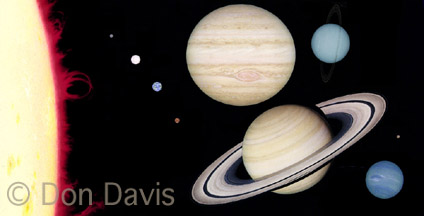 The
planets and their moons are bright and dark, colorful and dull.
Variations of color and brightness distinguish many of the bodies
of the Solar System, and a few stand out as unique. The brightness,
or percentage of the light reflected from a world (or sample thereof)
is expressed as its 'albedo'. In the images I have tried to correctly
color balance the image and present plausible contrast levels.
Where noted, absolute brightness, or albedo, of the world has
been incorporated into the images. At right is an effort to provide
'telescopic' views of the planets giving something of the visual
impression one gets when seeing a sunlit object against a wide
black background. This effect is discussed in more detail in the
Mars Pages.
The
planets and their moons are bright and dark, colorful and dull.
Variations of color and brightness distinguish many of the bodies
of the Solar System, and a few stand out as unique. The brightness,
or percentage of the light reflected from a world (or sample thereof)
is expressed as its 'albedo'. In the images I have tried to correctly
color balance the image and present plausible contrast levels.
Where noted, absolute brightness, or albedo, of the world has
been incorporated into the images. At right is an effort to provide
'telescopic' views of the planets giving something of the visual
impression one gets when seeing a sunlit object against a wide
black background. This effect is discussed in more detail in the
Mars Pages.
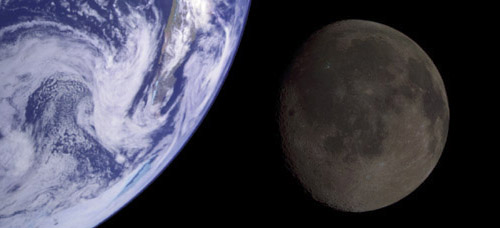 Earth
is a complex world to measure the brightness of, with a calculated
average albedo of 0.37. Most of the planet is under an ocean reflecting
only about 3.5 per cent of the sunlight neglecting specular reflection.
Clouds reflect about 78 percent of the light, and about 50 percent
of the surface is covered by clouds at a given time, biased toward
the poles. Land areas range from a dark 4.3 percent for forests
and about 7 percent for vegetation rich ground such as fields
to 13 percent for arid rocky regions.Only the brighter and higher
altitude regions are largely free of the blue overlay of the atmosphere.
(Some of these figures are from measurements quoted in 'Visual
Illusions' by M. Luckiesh, Dover Publications Inc. 1965.) The
Moon is overall quite dark, with an average albedo of about 0.12.
The dark maria tends to be a bit 'bluer' than the cratered highlands,
at some 7-10 per cent reflectivity. Local noticeably red and blue
regions exist both on maria and highland surfaces.. The highlands
reflects about 20-25 percent or so, with very fresh impact craters
strewn with rocks and molten glass as bright as 40 percent. (The
background gray on this page is set at 50 percent.) These figures
are extrapolated from those in Apollo preliminary science reports.
Both bodies are shown at their aproximate actual relative albedos
and colors.
Earth
is a complex world to measure the brightness of, with a calculated
average albedo of 0.37. Most of the planet is under an ocean reflecting
only about 3.5 per cent of the sunlight neglecting specular reflection.
Clouds reflect about 78 percent of the light, and about 50 percent
of the surface is covered by clouds at a given time, biased toward
the poles. Land areas range from a dark 4.3 percent for forests
and about 7 percent for vegetation rich ground such as fields
to 13 percent for arid rocky regions.Only the brighter and higher
altitude regions are largely free of the blue overlay of the atmosphere.
(Some of these figures are from measurements quoted in 'Visual
Illusions' by M. Luckiesh, Dover Publications Inc. 1965.) The
Moon is overall quite dark, with an average albedo of about 0.12.
The dark maria tends to be a bit 'bluer' than the cratered highlands,
at some 7-10 per cent reflectivity. Local noticeably red and blue
regions exist both on maria and highland surfaces.. The highlands
reflects about 20-25 percent or so, with very fresh impact craters
strewn with rocks and molten glass as bright as 40 percent. (The
background gray on this page is set at 50 percent.) These figures
are extrapolated from those in Apollo preliminary science reports.
Both bodies are shown at their aproximate actual relative albedos
and colors.
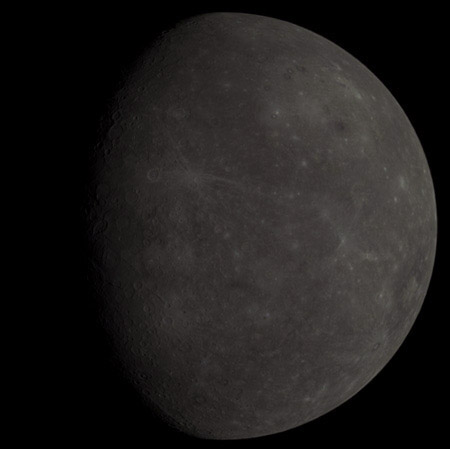 Mercury
(right) is probably similar in albedo and color to the Moon, although
perhaps with less contrast between the lighter and darker regions.
the albedo of Mercury is quite low, about 0.11. This image is
tuned to approximate the actual albedo and colors of Mercury
Mercury
(right) is probably similar in albedo and color to the Moon, although
perhaps with less contrast between the lighter and darker regions.
the albedo of Mercury is quite low, about 0.11. This image is
tuned to approximate the actual albedo and colors of Mercury

The cloud tops of Venus (left) are visually
brilliant white, with a high albedo of 76 percent. Only the faintest
trace of the darker tan cloud detail can be detected through telescopes,
however ultraviolet images bring out such detail well. NASA image
processed by Ricardo Nunes.
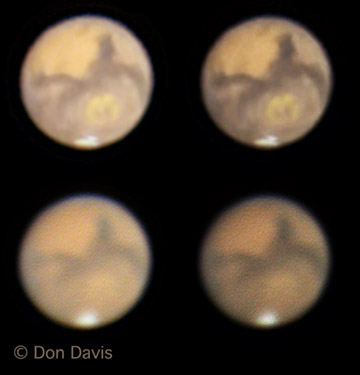 Mars
has long been known to be divided between light and dark regions.
The darkest areas are mostly exposures of dark gray basaltic rock.
The 'desert' regions are a lighter yellow ochre brown. Mars is
rather dark, its albedo an average of 0.16. The darker regions
approach the color and brightness of the Lunar maria, with the
widespread dusty deserts lighter than the average. The image at
left builds upon a photograph made at the eyepiece of the Mt.Wilson
60" reflector by drawing over the photograph using sketches
and notes made at the eyepiece to capture the visual impressions
(top row). The right hand versions are 'darkened' to remove some
of the luminous 'dazzle' which is with time reduced in the eye
by buildup of the after images of a bright object, giving better
visual color detection. A color digital camera carefully tuned
to reproduce sunlit darker scenery would probably obtain results
similar to the lower right version. Of interest is the more saturated
orange coloring of the northern deserts west of Syrtis Major,
(the major wedge shaped dark marking extending well into the north.)
The southern 'Hellas' basin, in between Sytris Major and the Southern
Polar Cap, consistantly appears a distinct yellow to me whenever
I
Mars
has long been known to be divided between light and dark regions.
The darkest areas are mostly exposures of dark gray basaltic rock.
The 'desert' regions are a lighter yellow ochre brown. Mars is
rather dark, its albedo an average of 0.16. The darker regions
approach the color and brightness of the Lunar maria, with the
widespread dusty deserts lighter than the average. The image at
left builds upon a photograph made at the eyepiece of the Mt.Wilson
60" reflector by drawing over the photograph using sketches
and notes made at the eyepiece to capture the visual impressions
(top row). The right hand versions are 'darkened' to remove some
of the luminous 'dazzle' which is with time reduced in the eye
by buildup of the after images of a bright object, giving better
visual color detection. A color digital camera carefully tuned
to reproduce sunlit darker scenery would probably obtain results
similar to the lower right version. Of interest is the more saturated
orange coloring of the northern deserts west of Syrtis Major,
(the major wedge shaped dark marking extending well into the north.)
The southern 'Hellas' basin, in between Sytris Major and the Southern
Polar Cap, consistantly appears a distinct yellow to me whenever
I 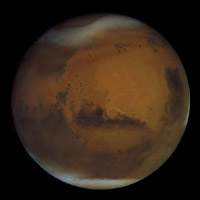 have had a good look
at it, even in a 6 inch telescope.
have had a good look
at it, even in a 6 inch telescope.
To the right is a roughly color balanced and
albedo adjusted version of Mars, like a 'sand painting' done with
actual surface materials.
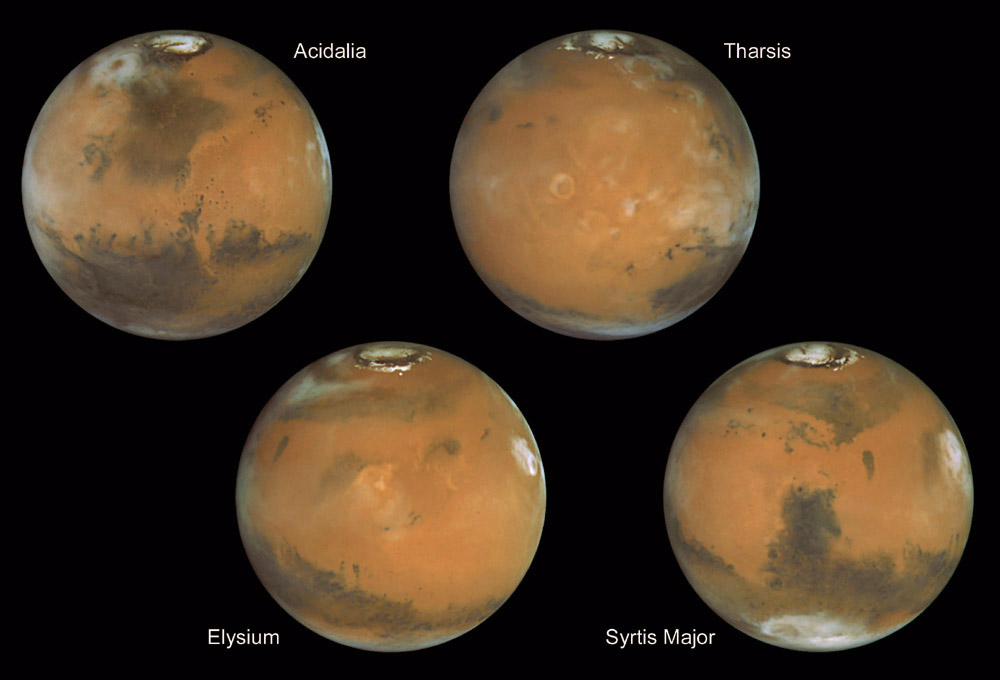
Below is an attempt to do 'fine tuning' color
balancing on a series of Hubble Mars images, treating the deserts
and dark areas seperately but not adjusting the tonal values to
preserve the albedo variations. Clouds and polar ice deposits
highlight the planet.
I invite those who are interested to visit
my page on The True Colors Of
Mars. Some controversy has been circulated
cregarding that subject, with immense divergences of ways of regarding
such problems evident.
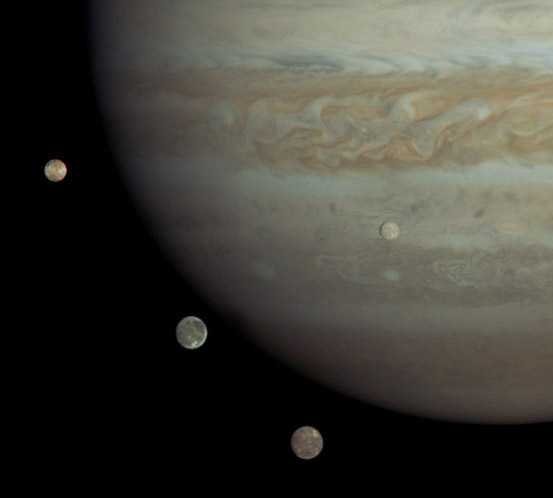 Jupiter
has several narrow belts of distinct colors as well as reddish
oval shaped stable cyclonic weather zones such as the 'Great Red
Spot'. The overall albedo of the planet is 0.52. The colors shown
in the strips are of the wider alternating belts and zones extending
from either side of the often white equatorial zone.
Jupiter
has several narrow belts of distinct colors as well as reddish
oval shaped stable cyclonic weather zones such as the 'Great Red
Spot'. The overall albedo of the planet is 0.52. The colors shown
in the strips are of the wider alternating belts and zones extending
from either side of the often white equatorial zone.
This is a Cassini image assembled from several
similarly color balanced images to approximate the colors, contrast
and albedos of the planet and four largest Moons ( Left to right:
Io, Ganymede, Callisto, Europa) appearing in the various photos.
Io should actually be a good deal yellower.
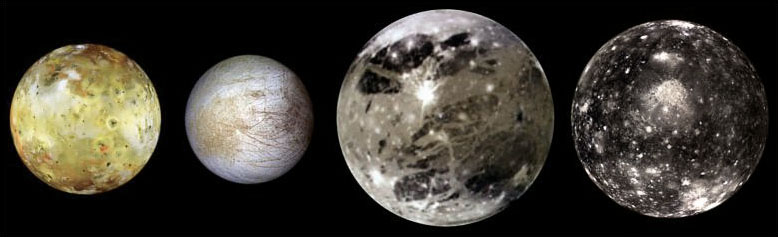
Io, the large volcanic satellite of Jupiter,
was first fully revealed in images transmitted from the Voyager
spacecraft. Unfortunately their cameras had no red filters and
color pictures had to be extrapolated substituting orange for
red and violet for blue. In the case of Io this led to a garish
'pizza' appearance with many reproductions of the released images
further wandering toward the red until Io looked like tomato soup!
Io is very bright, and largely a pale yellow with gray to dull
orange regions. Galileo has greatly refined the color information
from Io. The albedo of Io, (left, below) is a bright 0.6. That
of Europa is 0.64. Ganymede 0.42, and dark Callisto (right) 0.2.
This montage has roughly proper color but poorly constrained contrast
and brightness levels.
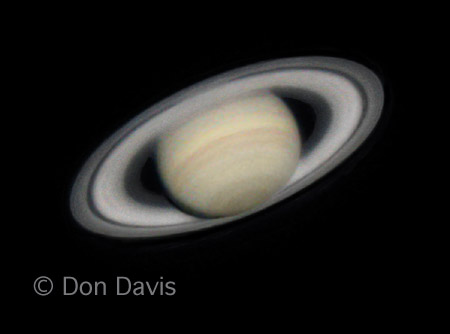 Saturn
is a more subdued colored world, an albedo of 0.47 making it only
slightly darker than Jupiter. The rings are actually more of a
brown gray color than we see them from Earth, as we are always
nearly 'in line' with the Sun and thus generally see the 'zero
phase' region with no shadows and pronounced 'back scattering',
all tending to bring a familiar yet atypical white ringed Saturn
to our view. At left is my visual impression of a combination
of the best moments of seeing of Saturn through the Mt. Wilson
60" telescope.
Saturn
is a more subdued colored world, an albedo of 0.47 making it only
slightly darker than Jupiter. The rings are actually more of a
brown gray color than we see them from Earth, as we are always
nearly 'in line' with the Sun and thus generally see the 'zero
phase' region with no shadows and pronounced 'back scattering',
all tending to bring a familiar yet atypical white ringed Saturn
to our view. At left is my visual impression of a combination
of the best moments of seeing of Saturn through the Mt. Wilson
60" telescope.
The Voyager spacecraft approached from a different
angle than our view and viewed the sunlit rings as they generally
appear, darker than the planet. These flybys used cameras with
color filters difficult to assemble true color images from, using
orange, green and violet filters. A very nice 'Hubble Heritage'
natural color Saturn image with realistic contrast can be seen
here.
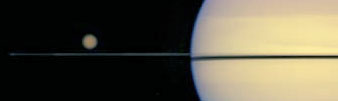
Below right can be seen a Hubble space telescope Saturn image
including its large moon Titan.
Saturn is seen below as imaged with RGB wavelengths
by Cassini, with colors and saturation adjusted to approximate
Earth based measurements of the color and albedo.
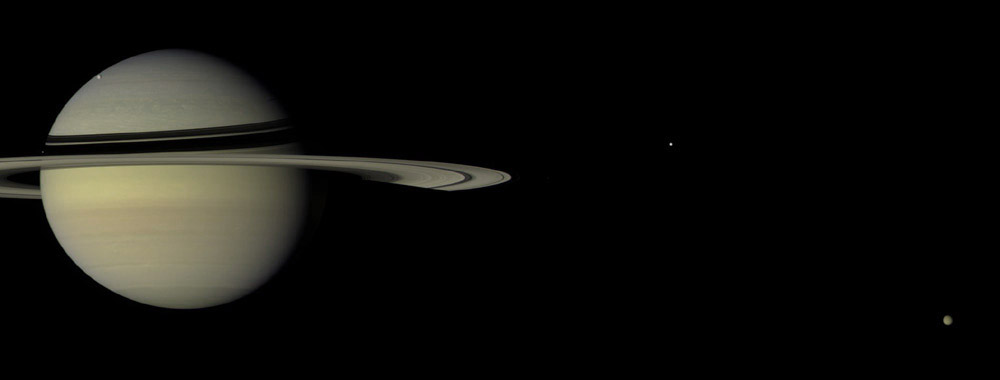
Titan, the large moon of Saturn at the lower
right of the photo above, is covered with clouds which prevents
us from seeing the surface. The color of these clouds is a pale
subdued tan with an albedo of 0.21. Photos of this tan cloud enshrouded
moon can be found on this
page.
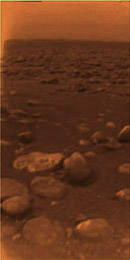
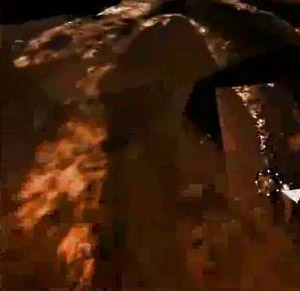
Measurements by the Huygens probe have resulted
in this image being presented as a 'true color' sampling of the
terrain viewed on the way down (left) finally landing on a gravelly
region apparantly subject to periodic flooding and obtaining repeated
scans of the same narrow close up (right) whose colors I bring
to rough conformity with the other image. If one were standing
there the scene would be at a light level comparable to 1000 full Moons.
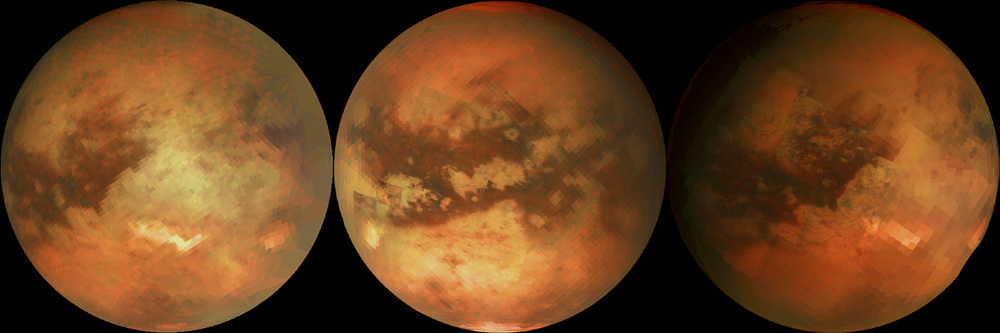
If one could strip away the clouds and atmosphere
of Titan the exposed surface mught appear something like this
extrapolated from measurements from a small region by the Huygens
probe as presented above. The wavelengths used for these global
views are well apart from visual bands so the tentative nature
of such a presentation is obvious.
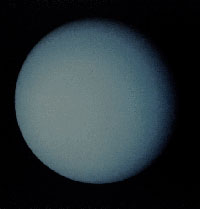
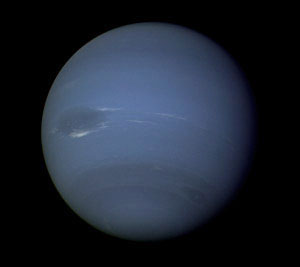
Uranus (left) is a pale sky blue gray, with
an albedo averaging 0.5. , as suggested by the treatment of this
image.Upon occasion white clouds are seen across the planet.
Neptune (right) is bluer than Uranus
and has more pronounced but apparently unstable cloud details.
At it's distance from the Sun, 30 times that of Earth, color estimates
begin to be compromised by the dimness of the light acting near
the threshold of human color vision. The albedo of Neptune is
about 0.41, with the albedo so adjusted here.
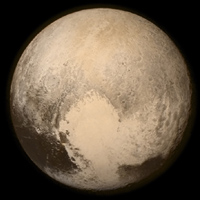
Pluto (left) has intriguing surface details,
with pronounced contrast between latitudinal zones.. The albedo
of Pluto ranges from 0.08 to 1.0!
I have made a template to provide
some attempt at 'true color' planetary color patches. They are
revised and expanded versions of painted color patches I prepared
after seeing the Planetary color article in the June 1985 Sky
and telescope by Andy Young. I corresponded with the author who
kindly sent me color chips which I used as a guide for my own
efforts. He is of course not responsible for any errors made here.
These are approximate average values but should be 'within the
ballpark'. Unless indicated all the colors aim towards a 'naked
eye impression' of the color types seen under noontime sunlight
conditions or the colors of cloud tops under similar lighting
conditions. The color sample should be printed on a high quality
printer and ideally viewed in diffused sunlight.
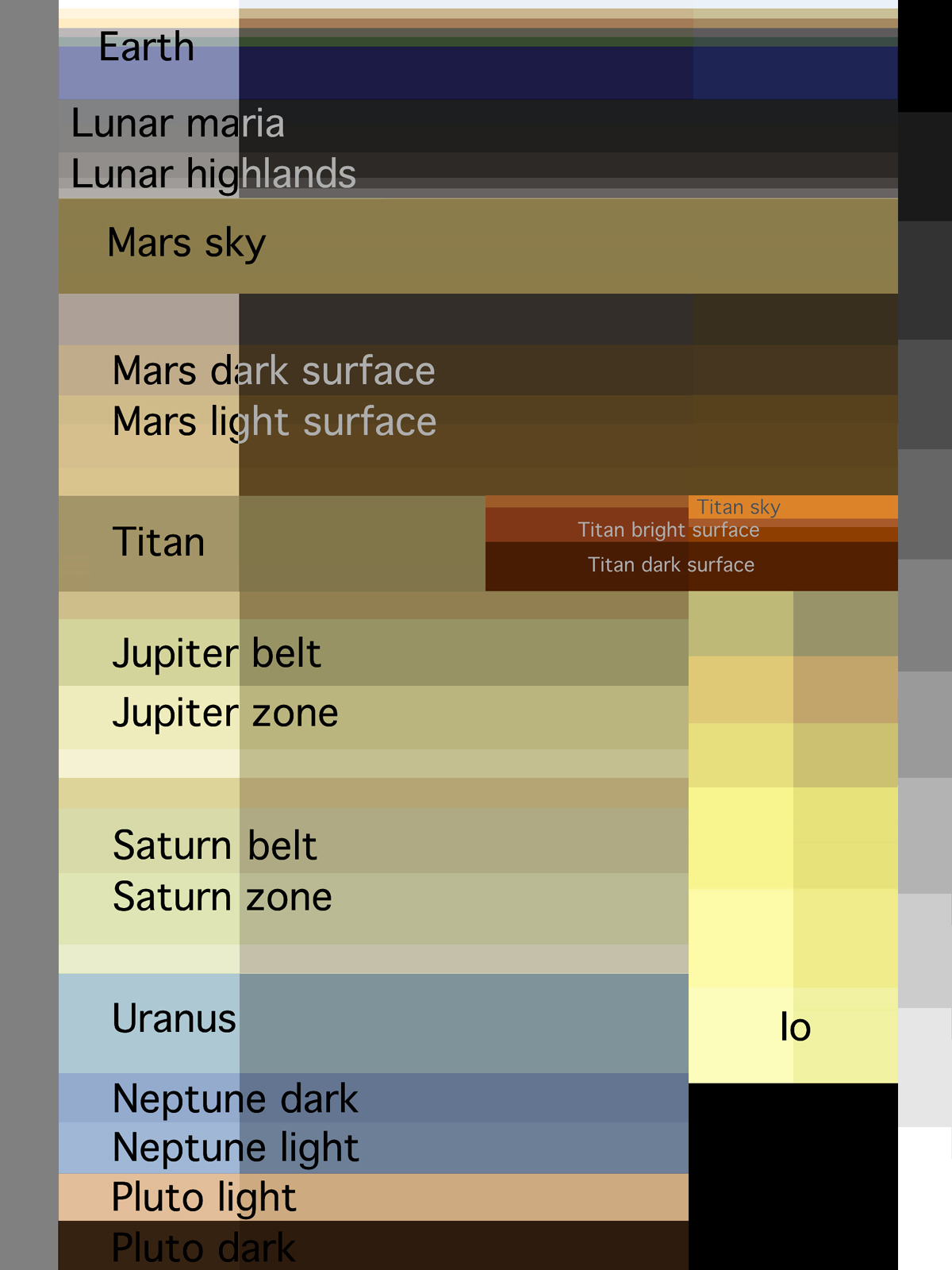
Below is my attempt at a set of color reference
strips for some of the planets. Revised July 2008. The left strips
suggest the view through telescopes of a small disk against the
black background of space, which brightens their appearance compared
to having them fill your visual field. The middle portion of the
various color strips suggest the color and brightness of planetary
surfaces (or upper cloud layers seen from above) under neutral
white sunlight. The subtle color shifts of the surface color patches
for Mars and Titan on the far right suggest the effects of the
ambient lighting from the sky color on the surface surroundings.
Some attempt is made to include some samples
of typical color variety across the world in question. The 'Earth
colors' are in 6 steps in descending order- ice, desert sand,
darker deserts, light vegetation, heavy vegetation and ocean.
As a departure from the other color samples, the right portions
of the Earth strips suggest the effects of contribution of the
overlay of the atmosphere to the appearance of Earth from space
near the middle of the disk.
For the Moon there are 5 steps-'blue' maria,
'reddish' maria, old highlands, fresher craters and mountainsides
and 'ray' making fresh crater ejecta Mars has 5 steps under the
sky color patch, dark basaltic rock surfaces, moderately dusty
highlands, lighter soil, overall dust, and lighter soils and rocks.
Titan is represented by first the cloud top color on the left,
to the right are 3 steps under the presumed sky color-ice dominated
highlands, medium highland and blocky surfaces, and flat darker
lowlands. Jupiter and Saturn are given 4 steps-darkest belts,
overall darker areas, overall lighter zones, exceptionally light
areas. Io with its range of hues is shown with similar convention
of telescopic (left) and as if viewing powdered compressed samples
(right) Neptune and Pluto have 2 steps shown. Pluto has been updated
to show the brightness and color range revealed by results from
the New Horizons flyby.